
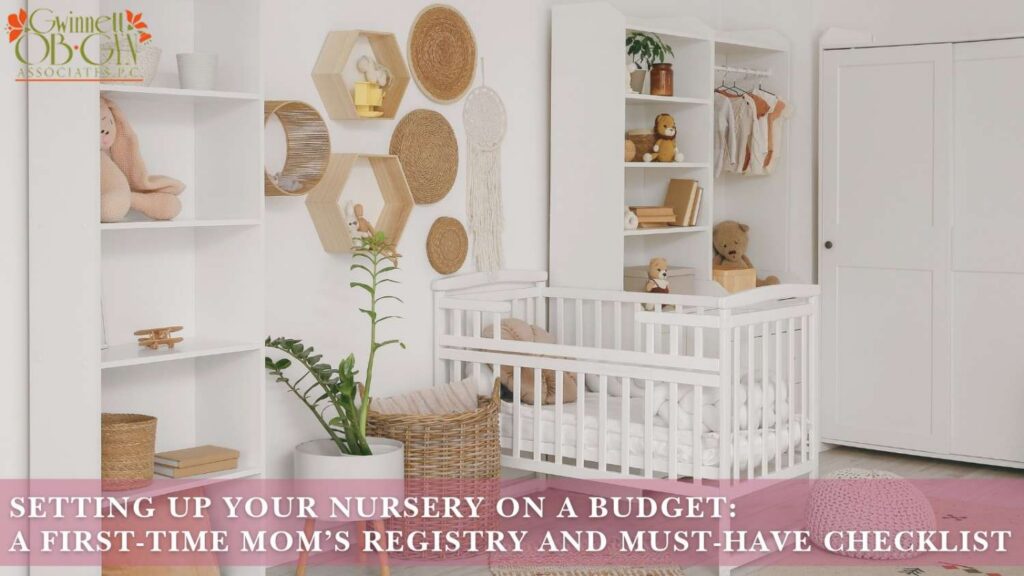
A functional, safe nursery for a newborn requires far fewer items than most registry guides suggest. Newborns need safe sleep, diapering supplies, clothing and feeding equipment, and a focused checklist built around those four categories keeps costs manageable without cutting corners on safety. The nursery industry markets heavily to first-time parents, and the gap between what is genuinely necessary and what is sold as essential is significant. Your prenatal care provider can help you sort through preparation questions at your second and third trimester visits, including what to prioritize before your due date.
What Does a Newborn Actually Need in the First Three Months?
Newborns have four genuine needs in the first trimester of life: a safe place to sleep, diapering supplies, clothing and a feeding setup. Everything sold beyond those four categories is either a convenience item, a duplicate of something you already have or something your baby will not use for months. Starting the registry with only these categories in mind and adding extras after the essentials are covered keeps the list from ballooning into an expensive, partially used collection of gear.
The sections below cover each category with specific items, approximate costs and a clear list of what to skip. The registry and secondhand sections that follow the category breakdowns cover how to build the list strategically and where to save money safely.
What Is the Safest Sleep Setup for a Newborn?
Safe sleep for a newborn means a firm, flat surface with a fitted sheet and nothing else in the sleep space. AAP safe sleep guidelines are specific: no bumpers, no positioners, no sleep wedges and no loose bedding of any kind. Back-to-sleep positioning on a firm mattress is the standard, and the sleep space itself does not need to be elaborate or expensive to meet it.
Two options cover the safe sleep requirement at different price points:
| Item | What to Look For | Approximate Cost |
| Standard crib | CPSC-certified, fixed sides, slat spacing no wider than 2.375 inches; many models convert to toddler bed | $100 to $300 |
| Bedside bassinet | Firm flat insert, ventilated sides; useful for room-sharing in months 1 to 4 before transitioning to crib | $80 to $200 |
| Crib mattress | Firm, flat and CPSC-certified; fits snugly with no gaps at the sides | $40 to $120 |
| Waterproof fitted sheets | Two to three minimum; allows nighttime changes without full bedding replacement | $10 to $20 each |
A standard low dresser with a contoured changing pad on top handles diapering without a dedicated piece of furniture. That setup is covered in the diapering section below. The sleep space budget stays lower when the crib serves only as a sleep space and the dresser handles both clothing storage and diaper changes.
A baby monitor is worth including on the registry. An audio monitor covers the functional need for most setups. Video adds convenience but is not a safety requirement.
What to skip: bumper pads, sleep positioners, wedges, thick quilts, decorative pillows and any item placed inside the sleep space. None are recommended by AAP and all add unnecessary cost.
ALSO READ: The Tdap Vaccine in Pregnancy: Why Timing Matters for Your Newborn
What Diapering Supplies Do You Actually Need?
A changing surface, diapers, wipes and rash cream cover the complete diapering need for a newborn. A dedicated changing table is a single-purpose piece of furniture that costs $100 to $300 and becomes unnecessary within two years. A contoured changing pad with a safety strap placed on top of a low dresser is functionally identical, costs $20 to $40 and gives the dresser a second use that extends well past the diapering stage.
Diaper quantity before the baby arrives is where most first-time parents overbuy. Newborns use 8 to 12 diapers per day, but newborn size is outgrown quickly, often within two to four weeks for average-sized babies. Stock 1 to 2 packs of newborn size and 4 to 6 packs of size 1 before the due date rather than loading up on newborn diapers that may go unused.
| Diapering Essential | Notes | Approximate Cost |
| Contoured changing pad with safety strap | Placed on dresser top; washable cover included in most | $20 to $40 |
| Disposable diapers (size 1 focus) | Register for size 1 rather than newborn in bulk | $20 to $30 per box |
| Unscented baby wipes | Fragrance-free reduces irritation risk | $15 to $25 for bulk pack |
| Zinc oxide diaper rash cream | Standard first-line recommendation | $8 to $12 |
| Portable diaper caddy | Keeps supplies accessible in any room | $15 to $25 |
What to skip: wipe warmer, dedicated changing table, elaborate diaper organizing systems and a separate diaper pail if a standard lidded bin with bags is already available.
How Many Baby Clothes Does a Newborn Need?
Ten to fifteen pieces of clothing covers the first six to eight weeks without requiring daily laundry. More than that creates storage problems and generates significant waste since babies outgrow sizes faster than the clothing wears out.
A practical newborn clothing stash looks like this:
- 6 to 8 onesies: mix of short and long sleeve depending on birth season; snap or envelope neck closures work well
- 4 to 6 zip-up sleepers: zip closures are significantly faster than snaps during nighttime changes
- 2 to 3 muslin swaddle blankets: lightweight, breathable and used for swaddling, burping and light coverage
- 2 baby hats and 2 pairs of mittens: used primarily in the first few weeks; babies grow out of these quickly
Buy mostly 0 to 3 month sizing rather than newborn. Many babies are born at or above the upper end of the newborn size range and skip it entirely, or outgrow it within two to three weeks. Neutral colors extend the resale value and usefulness across future pregnancies.
What to skip: newborn shoes, formal or dressy outfits, large quantities of any single size and any clothing requiring ironing or delicate washing. Babies spend their first weeks in sleepers and onesies, and anything more complicated than that serves the adults looking at the baby rather than the baby wearing it.
ALSO READ: How Long It Takes To Lose Pregnancy Weight
What Feeding Supplies Should Go on Your Registry?
Feeding setup depends on method, and the right registry list differs between breastfeeding and bottle feeding. Both setups share a few items regardless of method.
Shared essentials for both methods:
- 12-pack muslin burp cloths: used constantly regardless of how the baby is fed
- Nursing pillow (Boppy or equivalent): supports positioning for breastfeeding and bottle feeding equally
Breastfeeding additions:
- Breast pump: covered by most insurance plans under the ACA; confirm coverage with your insurer before purchasing since plans vary; register for a specific model after confirming what your plan covers
- Nipple cream (lanolin-based): high utility in the first weeks of nursing
Bottle feeding additions:
- Starter set of 4 to 6 bottles: brand matters less than finding a nipple flow rate the baby accepts; start with one brand and adjust after the baby arrives
- Bottle brush and drying rack
What to skip: a standalone bottle sterilizer (the dishwasher top rack achieves the same result), large quantities of one formula brand before knowing what the baby tolerates and more than one or two bottle styles before testing what works.
How Do You Build a Baby Registry on a Budget?
A registry built around genuine essentials and funded strategically through platform discounts and group gifting covers most of the newborn setup without leaving the budget entirely to chance. Three platforms are worth knowing before opening a registry.
- Babylist functions as a universal registry that pulls items from any retailer. Price comparison is built in, and guests can purchase from whichever store has the best current price. It is the most flexible option for a budget-conscious registry because it is not tied to a single retailer’s pricing.
- Amazon Baby Registry offers a completion discount of 15 percent for Prime members on unpurchased registry items after a set date. The discount window typically opens 60 days before the due date.
- Target Baby Registry offers a similar completion discount plus a welcome kit with samples at sign-up. Target’s in-store registry scanner makes it easy to add items across categories during a single shopping visit.
Registry timing and strategy:
- Start the registry by week 20 so it is ready before any baby showers are planned
- Mark large items such as the crib, car seat and stroller as group gift options so multiple people can contribute rather than one person covering the full cost
- Use the priority setting to distinguish genuine needs from nice-to-have additions so guests can make useful choices
- Add one or two items per category above your actual budget ceiling since guests often give slightly above the baseline, and those items cover costs that would otherwise come out of pocket
Your first prenatal visit establishes your due date, which anchors the registry timeline. Starting the registry shortly after that appointment puts you ahead of most planning schedules.
What Baby Items Should Never Be Bought Secondhand?
Buying secondhand is one of the most effective ways to reduce nursery costs, and it is the right call for most categories. Three items are worth purchasing new when possible, and understanding why makes it easier to prioritize where the budget goes.
- Car seat: Expiration dates, full usage history and recall status are difficult to confirm on a secondhand seat. CPSC recommends purchasing new for this reason. Many retailers, hospitals and nonprofit organizations offer low-cost or subsidized car seat programs for families who need them. Asking your provider or local health department is a good starting point for finding those resources.
- Crib: Crib safety standards have changed significantly over the years. Drop-side cribs were phased out in 2011, and older models may not meet current slat spacing requirements. A new CPSC-certified crib is the most straightforward way to confirm the sleep space meets current standards. If cost is a concern, many community organizations and baby banks offer new or like-new certified cribs at reduced or no cost.
- Breast pump: FDA classifies standard breast pumps as single-user devices because internal components are not designed for shared use. Hospital-grade rental pumps are a different category and are specifically designed for multiple users. These are widely available through hospitals, lactation consultants and some insurance plans at little or no cost.
Items that are generally safe to buy secondhand with appropriate checks:
- Clothing: wash before first use
- Glider or nursing chair: inspect joints and hardware for stability
- Bouncer or swing: confirm no open recalls via the CPSC recall database and check all parts are present
- Nursery décor, storage bins and organizational items
Buy-nothing groups, Facebook Marketplace and consignment sales are reliable sources for secondhand items in the safe categories. Checking the CPSC recall database before any secondhand purchase takes less than a minute and is worth the habit regardless of how new an item looks.
ALSO READ: Fertility And Why Age Matters
Schedule an Appointment at Gwinnett OB/GYN
Safe sleep guidance and infant feeding support are routine parts of prenatal care at Gwinnett OB/GYN. If you have questions about breastfeeding, safe sleep standards or what to expect in the early postpartum weeks, your provider is the right person to ask. Gwinnett OB/GYN has supported first-time mothers across Gwinnett County for over 45 years, and our obstetrics team is ready to walk you through both the clinical and practical sides of preparing for a newborn. Schedule an appointment and bring whatever questions are on your mind.
Frequently Asked Questions
When should I start setting up the nursery?
The second trimester, between weeks 14 and 27, is the practical window for nursery setup. Energy levels are typically higher than in the first trimester, and the third trimester brings physical limitations that make furniture assembly and organizing more difficult. Having the sleep space assembled and the diapering station stocked by week 34 to 36 leaves a comfortable buffer before most due dates.
What is the one thing I actually need before the baby comes home?
A safe sleep space. A firm, flat, CPSC-certified sleep surface with a fitted waterproof sheet is the single non-negotiable item before a newborn comes home. Everything else can be acquired in the first days and weeks after the baby arrives, making the sleep space the one item worth prioritizing above everything else on the list.
Do I need a dedicated nursery room or can the baby sleep in my room?
AAP recommends room-sharing without bed-sharing for at least the first six months of life, preferably the first year. A baby does not need a dedicated nursery room. A bassinet or crib in the parents’ room meets the AAP recommendation and eliminates the need to furnish a separate space entirely until the family is ready for that transition.
How much does it cost to set up a basic nursery?
A functional nursery covering all four essential categories, safe sleep, diapering, clothing and feeding, can be assembled for approximately $400 to $700 when purchases are made strategically. That range assumes a new crib or bassinet, a new mattress, a changing pad, two to three packs of diapers, 10 to 15 clothing pieces and a basic feeding setup. Registry completion discounts and secondhand purchases in the safe categories bring that number down further.
Can I use a Pack ‘n Play instead of a crib?
Yes. Pack ‘n Play models with a firm, flat bassinet insert meet AAP safe sleep standards and are CPSC-compliant when used as directed. They are portable, compact and significantly less expensive than a full crib, with most models ranging from $60 to $150. The bassinet insert has a lower weight limit than the full playard base, so check the manufacturer’s specifications and transition to the lower level or a crib when the baby reaches that limit.