
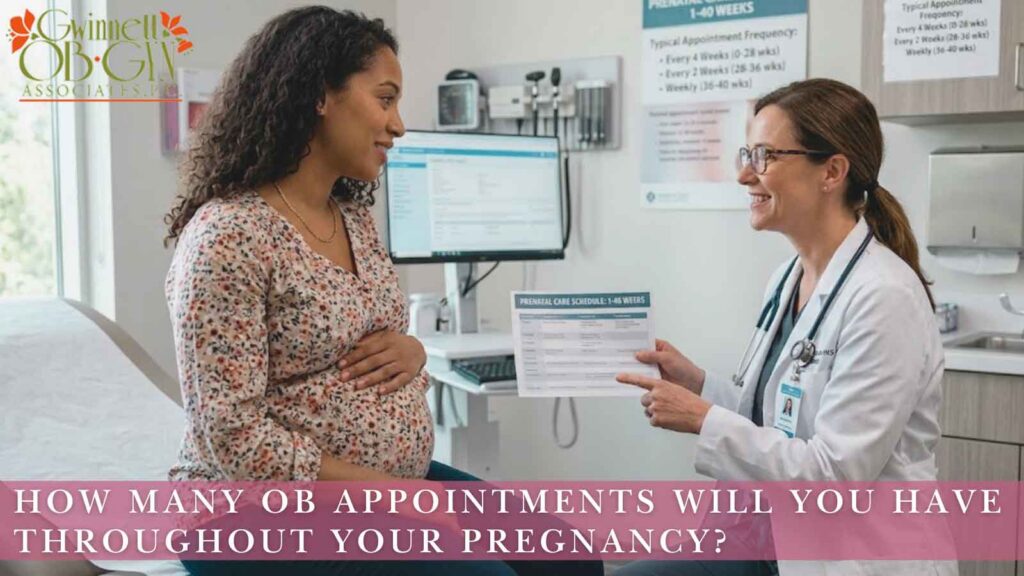
Most uncomplicated pregnancies require between 10 and 15 prenatal appointments in total, with visits spaced every four weeks in early pregnancy and becoming more frequent as the due date approaches. The schedule follows a predictable three-phase pattern: one visit every four weeks through 28 weeks, one visit every two weeks from 28 to 36 weeks and one visit every week from 36 weeks until delivery.
The exact number of appointments you have depends on your health history, how your pregnancy progresses and whether any conditions develop that require closer monitoring. Understanding the full prenatal appointment schedule from the start helps you plan around work, childcare and other commitments throughout the months ahead. Your obstetrics team will walk you through the schedule at your first visit and adjust it based on your individual clinical picture.
When Should You Schedule Your First OB Appointment?
Schedule your first prenatal appointment as soon as your pregnancy is confirmed. The first visit typically takes place at approximately 7 weeks gestation, which falls about three weeks after a missed period. Scheduling early ensures that your pregnancy is confirmed by ultrasound, your due date is established accurately and your care team has enough time to order any first-trimester bloodwork on the right timeline.
Plan to bring your insurance card, a photo ID and any completed new patient forms to your first visit, and arrive approximately 30 minutes early to allow time for check-in. The first appointment covers more ground than any visit that follows. Your nurse practitioner will review your full medical and reproductive history, a confirmation ultrasound will be performed to verify gestational age, and a comprehensive blood panel will be ordered. A financial advisor is also available at the first visit to review insurance coverage and billing questions before care is fully underway. For a closer look at what that blood panel includes, this overview of lab tests done during pregnancy visits breaks down each test and when it is drawn.
How Does the Prenatal Appointment Schedule Break Down by Trimester?
The prenatal visit schedule accelerates as pregnancy progresses, with each trimester bringing a different appointment frequency and a different set of clinical priorities.
| Trimester | Weeks | Appointment Frequency | Key Milestones |
| First | 4–12 | Every 4 weeks | First visit at ~7 weeks; dating ultrasound; comprehensive bloodwork; optional cell-free DNA and carrier testing |
| Second | 13–27 | Every 4 weeks | Anatomy ultrasound (18–22 weeks); glucose challenge test (24–28 weeks); fetal heart rate checks |
| Third (early) | 28–35 | Every 2 weeks | Fundal height; blood pressure monitoring; fetal heart rate; growth assessment |
| Third (late) | 36–delivery | Every week | Group B strep swab (35–37 weeks); cervical checks; birth plan review; delivery preparation |
The shift from every-four-week to every-two-week visits at 28 weeks marks the point at which the third trimester begins and the clinical focus moves toward preparing for delivery. Blood pressure, fetal position, fundal height and amniotic fluid levels all require closer tracking during this period, which is why the frequency of visits increases even when a pregnancy is progressing without complications.
What Happens at a Routine Prenatal Checkup?
Every routine prenatal checkup includes a core set of assessments that track both maternal and fetal health. Your provider checks your weight, blood pressure and urine at each visit, measures fundal height to monitor fetal growth and listens to the fetal heart rate. These repeated data points build a picture of how your pregnancy is progressing and allow your care team to identify any changes early.
The content of each visit evolves as your pregnancy advances. Early appointments focus on reviewing lab results, discussing optional genetic testing and establishing a baseline for your health markers. Mid-pregnancy visits center on anatomy scan findings, gestational diabetes screening and any questions that arise as the pregnancy becomes more physically present. Late-pregnancy visits shift toward cervical readiness, fetal position, birth plan discussion and delivery logistics.
What Key Tests Are Scheduled at Specific Appointments?
Several tests are timed to specific points in pregnancy and are built into the prenatal appointment schedule rather than added at the discretion of individual visits.
- Cell-free DNA and carrier testing: offered in the first trimester as optional prenatal screening; results help identify chromosomal conditions before the anatomy scan. More detail on these tests is available on the fetal testing page.
- Anatomy ultrasound: performed between 18 and 22 weeks to evaluate fetal organ development, placental position and amniotic fluid levels
- Glucose challenge test: administered between 24 and 28 weeks to screen for gestational diabetes; a follow-up three-hour test is ordered if the initial result is elevated
- Tdap vaccine: recommended between 27 and 36 weeks to provide newborn protection against whooping cough before birth
- Flu vaccine: recommended at any point during pregnancy during flu season
- Group B strep swab: collected between 35 and 37 weeks; a vaginal and rectal swab determines whether antibiotics are needed during labor. The vaccines during pregnancy page covers immunization timing and safety in more detail.
Do You Have More Appointments in the Third Trimester?
Yes. The third trimester brings the highest concentration of prenatal appointments in the entire pregnancy. Visits shift to every two weeks starting at 28 weeks and increase to every week starting at 36 weeks, meaning the final month of pregnancy alone accounts for four or more appointments. The acceleration reflects how much changes in a short period of time during late pregnancy. Fetal position, cervical changes, blood pressure patterns and amniotic fluid levels can all shift from one week to the next, and catching those changes early allows your care team to act before they affect delivery.
Some women also receive additional monitoring during the third trimester in the form of non-stress tests or biophysical profiles, even without a formal high-risk designation. These tests measure fetal heart rate response and movement and are typically added when a physician wants a closer look at fetal wellbeing in the weeks approaching delivery. For a breakdown of how ultrasound appointments fit into the third-trimester schedule specifically, this guide on how many ultrasounds you will have during pregnancy covers imaging frequency from the first trimester through the final weeks.
How Does a High-Risk Pregnancy Change the Appointment Schedule?
A high-risk pregnancy requires more prenatal appointments than the standard schedule outlines, with additional monitoring visits added based on the specific condition being managed. The standard 10 to 15 appointment framework applies to uncomplicated pregnancies; women with high-risk factors typically see their total visit count increase beyond that range, sometimes significantly.
Conditions that commonly increase appointment frequency include gestational diabetes, preeclampsia, multiple gestation (twins or higher-order multiples), advanced maternal age (35 or older), pre-existing hypertension and fetal growth restriction. Each of these conditions requires more frequent blood pressure checks, additional ultrasounds to assess fetal growth, non-stress testing or some combination of all three. The monitoring schedule is built around the specific condition and adjusted as the pregnancy progresses.
Gwinnett OB/GYN manages high-risk pregnancies in collaboration with Maternal-Fetal Medicine specialists, meaning patients continue their regular prenatal checkups at the practice while specialist input is coordinated through an established referral network. The two care teams communicate directly to ensure monitoring recommendations are integrated into your overall appointment schedule. The high-risk pregnancy page covers the conditions managed through this collaborative model and what the process looks like in practice. For women balancing work obligations alongside an elevated-risk diagnosis, this overview of working during a high-risk pregnancy addresses what adjustments are typically recommended.
What Happens After Delivery?
The prenatal appointment schedule concludes with a postpartum visit scheduled at 4 to 6 weeks after delivery for uncomplicated vaginal births, and earlier for cesarean deliveries or any recovery that requires closer follow-up. The postpartum visit covers physical recovery, blood pressure, wound healing where applicable, mood and emotional wellbeing screening and contraception counseling for women ready to discuss next steps.
All deliveries for Gwinnett OB/GYN patients take place at Eastside Medical Center, with an on-call obstetrician attending each birth. The postpartum visit brings the care journey full circle and gives your physician a structured opportunity to confirm that your recovery is on track before transitioning back to routine gynecologic care.
Schedule Your First Prenatal Appointment at Gwinnett OB/GYN
Gwinnett OB/GYN provides prenatal care from the first confirmation visit through postpartum follow-up, with board-certified physicians and nurse practitioners guiding patients through every stage of pregnancy. The practice operates on a collaborative care model, meaning patients meet all providers during pregnancy and are supported by a team rather than a single physician. Deliveries take place at Eastside Medical Center, located adjacent to the practice. With over 45 years of experience in women’s healthcare, Gwinnett OB/GYN coordinates both routine and high-risk prenatal care with the same attentive approach at every visit.
Call us to speak with our office or request an appointment online. Visit the obstetrics page to learn more about the full scope of prenatal care available at Gwinnett OB/GYN.
Frequently Asked Questions About Prenatal Appointments
How many prenatal appointments is normal?
Between 10 and 15 prenatal appointments is standard for an uncomplicated pregnancy. The exact number depends on how your pregnancy progresses, your health history and whether any conditions develop that require closer monitoring during the second or third trimester.
What week do OB appointments start?
Your first prenatal appointment is typically scheduled at approximately 7 weeks gestation, which falls about three weeks after a missed period. Scheduling as soon as pregnancy is confirmed ensures your due date is established accurately and your first-trimester bloodwork is ordered on the right timeline.
How often do you see your OB in the third trimester?
Prenatal appointments shift to every two weeks at 28 weeks and increase to every week starting at 36 weeks. The final month of pregnancy alone accounts for four or more visits, reflecting how closely fetal position, blood pressure and cervical changes need to be tracked as delivery approaches.
Do high-risk pregnancies require more appointments?
Yes. Women with conditions such as gestational diabetes, preeclampsia, multiple gestation or advanced maternal age require additional monitoring visits beyond the standard schedule. The frequency depends on the specific condition being managed and is adjusted as the pregnancy progresses.
What is the last prenatal appointment before delivery?
The final prenatal checkup before delivery typically takes place at 39 to 40 weeks, depending on how your third-trimester schedule has been structured. After delivery, a postpartum visit is scheduled at 4 to 6 weeks for uncomplicated vaginal births, and earlier for cesarean deliveries or recoveries that need closer follow-up.